
At the beginning of August, fueled by the upcoming Independence Day, I started reading and writing about Punjabi folktales, which eventually turned into Pakistani folktales.
And though you can find them all on Substack, I will still be sharing them here on my website as well. So, starting today, you'll get daily folktales that have inspired and been a cause of much discussion among the Pakistani folk.
In today's story, I will be going over one of my favorite songs and the story behind it.
The story of Sohni and Mahiwal, depicted in one of my favorite songs produced by Coke Studio, Par Channa De.
I heard this song a long time ago and instantly fell in love with it. And I discovered much later the history attached to it.
Welcome to the love story of Sohni and Mahiwal.
The story of Sohni and Mahiwal has two versions; one is Punjabi and the other Sindhi. I believe the song goes with the Punjabi version, as the river Chenab is mentioned, so we’ll discuss it first.
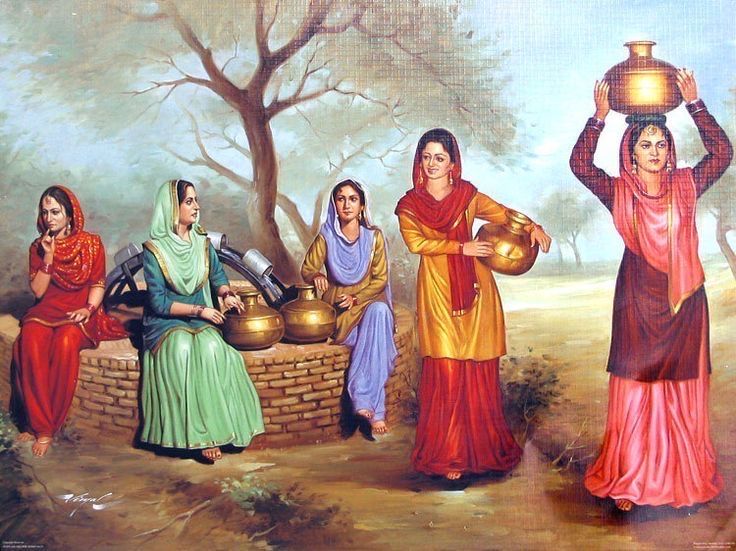
In the Punjabi version, Sohni is from the Kumhar community, a caste historically associated with pottery, and she is the daughter of a potter named Tulla. Their house was situated in Gujrat, which was located near the river Chenab and was a caravanserai on the trade route between Bukhara (Uzbekistan) and Delhi (India).
Their shop was said to be near the Ram Pyari Mahal, and Sohni would set these various pitchers (surahis) and water mugs up for sale right after decorating them with her designs.
Izzat Baig, Mahiwal, was a rich trader in Gujrat, and when he saw Sohni, was entranced by her right there and then. He would buy the pitchers just to get a glimpse of her.
Sohni also fell in love with him, and Izzat Baig became a servant of her house, even grazing their buffaloes, after which he got the name Mahiwal, which is buffalo herder in Punjabi.
The love story of the two caused a commotion and it was not approved that Sohni marry outside of her community, due to which her marriage was arranged with another potter.
On the other hand, Izzat Baig renounced the world and started living as a beggar. He began to live in a hut right across Sohni’s new home, which was on the other side of the river Chenab.
At the dead of night, the two lovers would meet each other in secret. Sohni would swim across the river towards Mahiwal with the help of an inverted hard baked pitcher.
The two would eat together, and one day, Mahiwal couldn’t catch the fish due to high tide so he cut up some of his thigh and roasted it. When Sohni found that out, their love only grew stronger.
 Chenab, Pakistan’s river of love
However, they were soon found out by Sohni’s sister-in-law, who informed her mother, Sohni’s mother-in-law. Sohni’s husband was out on a business venture when the two women discovered the hard baked pitcher Sohni used to swim, and they replaced it with an unbaked one.
When Sohni used it to swim to Mahiwal, the pot dissolved and she drowned with it. Mahiwal spotted her and jumped in to save her, drowning as well in the process. Thus the two lovers died together, vanishing in the river Chenab.
Most Punjabi love stories end in tragedy. And as far as I have researched, Sohni and Mahiwal were written quite before Romeo and Juliette. Funny, isn’t it?
Hope you all enjoyed the little story lesson today. I will go over the Sindhi version next time.